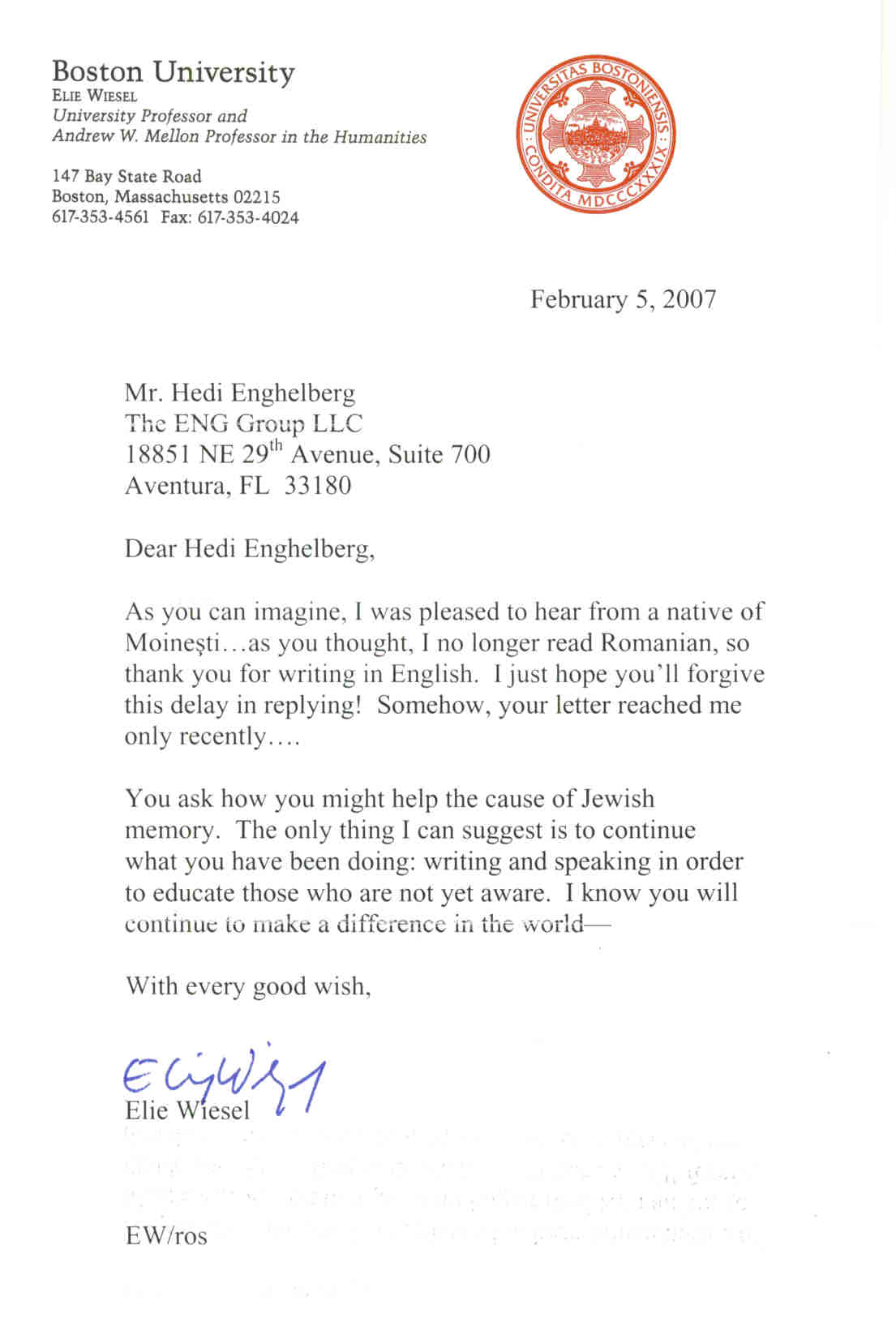
A prolific author of numerous published books, articles[1] and poetry, Hedi Enghelberg was born in Moineşti[1], Bacău Province, Romania to a Jewish Romanian family, Moises and Draga. His mother, Draga (Dorina), was evacuated from her native Moinesti to the Bacau Jewish Ghetto during WWII, and was liberated and returned to Moinesti in the fall of 1944.
His father, Moises Enghelberg (1919-1985) was very active in the Rumanian Oil Industry and was the last president (1973-1983) of the Moinesti Jewish Community [2].
Hedi's first book, is a historical biography and a tribute to his father. Entitled Escape del Ultimo Tren de Auschwitz [2] the book provides a brief history of World War II, the concentration camps, the persecutions Moises endured as a Jewish prisoner in the Romanian and German forced labor camps during World War II (1941-1944),and his escape on August 23-24th, 1944 from the last train headed to Auschwitz for extermination, only to be returned by the Russians who had driven the Germans back at the end of the war, to the continued Jewish persecution in Romania throughout the Cold War under Ceaucescu's communist regime. after two attemps, Moises Enghelberg was finally able to immigrate to Israel and freedom in December 16th, 1983 and celebrated the only and last birthday he was ever to experience free from persecution as a Jew on August 8, 1984.
Escape del Ultimo tren de Auschwitz originally written in Spanish, is currently undergoing translation into English and other languages as are the rest of Hedi's books. The Spanish version is already included in collections of libraries and museums worldwide as reference material for students, researchers and scholars studying the Holocaust and Genocide. This historical biography is included in the U.S. Holocaust Museum's list of Biographies on the subject which is widely distributed in publications such as the Oxford Journal's ((Oxford University Press) Spring 2002 Edition "Recently Published Works in Holocaust and Genocide Studies" under the heading of Biography and Autobiography [3]. This book is also part of the following collections covering the Holocaust:
AUSCHWITZ-BIRKENAU
CONCENTRATION CAMP
MUSEUM
U.S. HOLOCAUST MUSEUM,
WASHINGTON DC
THE LIBRARY OF CONGRESS
(WWW.LOC.GOV)
HOLOCAUST MUSEUM BERLIN
RUMANIAN NATIONAL
LIBRARY
BIBLIOTEQUE NACIONAL DE
FRANCE
BIBLIOTECA NACIONAL DE
ESPANA
MIAMI PUBLIC LIBRARY
BIBLIOTECA NACIONAL DE
VENEZUELA (BNV)
YAD VA-SHEM, ISRAELI
HOLOCAUST MUSEUM
EMBASSY OF THE UNITED
STATES IN VENEZUELA
EMBASSY OF ISRAEL IN
VENEZUELA
UNIDAD EDUCATIVA MORAL Y
LUCES HERTZ-BIALIK
CARACAS/VE
DAVID POSNAK HEBREW DAY
SCHOOL, MARGATE, FL/USA.
The book has received
favorable reviews in
Venezuela
[3] as well as
in the Pompano Times
[4]
Ciberterrorismo (Cyberterrorism)[5]
was one of the first
white papers published
on the topic of
Cyberterrorism, a new
weapon in the arsenal of
global terrorists to be
used for waging
asymmetrical warfare. It
was also one of the
first resources
available and used in
works consulted and
bibliographies in
subsequent papers
written about this new
method of committing
acts of terrorism
through cyberspace (the
internet) which we now
know as cyberterrorism.[6]
[4]
[7][5]
“Ciberterrorismo/Infowars” based on over 13 public conferences held in both Venezuela and the U.S. (Barnes and Noble), at the time of its publication in Venezuela, was one out of only a handful of books worldwide, alerting the public, corporations, and state institutions and agencies about this new trend and dimension of war: the cyberspace (traditional air, ground, water). In principle the CYber terrorism is the continuation of terrorism by a new means and ways: cyberspace, networks, computers and Internet.
The H-Clone, like
Enghelberg's
aforementioned books,
deals with current
events and issues of the
day. Although The
H-Clone is a fiction-based-on
fact novel, the subject
matter is fast becoming
one of the most
controversial issues of
the day: Cloning,
specifically human
cloning. Beginning and
set in the last days of
World War II and the
Battle of Berlin,
readers are introduced
to cloning and a brief
explanation of how it is
performed. The setting
is Hitler's bunker and
Enghelberg postulates
that Hitler's and
Bormann's samples of
hair, nails, skin and
sperm were taken,
preserved in cryo-containers
and smuggled out of
Berlin to Argentina
right after Hitler
supposedly committed
suicide and was buried
in the terrace of the
Foreign Ministry
building. The story
takes readers from
Germany to London where
Mossad agents are sent
for the containers,
board the Israeli
submarine Dakar, which
mysteriously sinks right
off the coast of Haifa's
port. Most personages,
places and events
throughout the book are
factual and historical.
Only a few characters
such as Hanna, the
Mossad agent sent to
find and recover the
Hitler's genetic
material are fictitious.
Readers are taken from
Tel Aviv to Moscow and
Argentina in this
science-based spy
thriller, but more
importantly, they are
introduced to the
science of cloning and
what it implies now and
in the future. The book
is currently being
revised and translated
and will continually be
updated as the
technology of cloning
progresses and as
society adopts whatever
changes it deems
desirable or necessary
in response to the moral
and ethical questions
and issues presented by
the ability of cloning
life. Is cloning animals
for food acceptable? Is
it safe? The FDA claims
it is[6],
while a consumer's
advocacy group, the
Center for Food Safety
claims that it isn't
[7] while a The
New York Times
article quotes Joseph
Mendelson, the advocacy
group's legal director
that: “At the end of the
day, F.D.A. is looking
out for a few cloning
companies and not for
consumers or the dairy
industry.”[8]
Is it ethical or moral
to clone cats to glow in
the dark?[9]
How about human organ
parts? How about human
beings for the purpose
of harvesting their
organs to save other
humans' lives? Should
laws be passed to forbid
it, if deemed unethical?
If these laws are passed,
will criminal elements
still be able to avail
themselves of it like
they currently get guns?
Questions and more
questions as scientists
continue to make
important strides in
cloning despite serious
misgivings about whether
ultimately it won't
degrade the human
condition and life
itself becomes less
valuable. Cloning has
become a reality in such
a short time thanks to
what is described in The
H-Clone, the vast data
accumulated by Hitler's
physician, the infamous
Dr. Joseph Mengele who
was able to skip studies
performed on laboratory
animals and perform
direct human studies on
the large pool of humans
he had available and
even to perform special
selections from the
inmates of Nazi
Germany's death camps.
The H-Clone is in the process of being revised and translated into English and will be published in 2008.
Enghelberg has also written the following books in Spanish:
- Codename: Capital (about the first two hours of the Yom Kippur war, the Golan Heights, October 06th, 1973)
- The Block 19 Project (about the WWII and neo-terrorism)
Enghelberg has also written articles for Spanish-language publications in Venezuela, such as El Globo, El Universal and El Nuevo Mundo Israelita. He reviewed films for Venezuelan newspapers.
Hedi Enghelberg finished a new book, his latest one, also in Spanish. It is a collection of poetry both his own and his son's: “Poemas del Medio Dia” , 33 Poems by Hedi Enghelberg and “LA RISA NERVIOSA”, 13 POEMS BY MOISES ENGHELBERG.